Arda A.I. Portfolio

Slip 'N Slime

Steam Ratings:

(95% Positive Reviews)

Engine: Godot

Role: Level Designer

Team Size: 10

Studio: Wild Magic Studio

Publisher: SpaceJazz

Genre: Puzzle | Sokoban | Adventure

Platform: PC & Mobile

Goals & Responsibilities

Design and create engaging levels and gameplay mechanics for the Sokoban/puzzle genre, aligned with the project’s vision and principles.
Ensure new mechanics are fun, synergize well with existing gameplay, and stay within production limits / scope.
Design a clear, intuitive world map that supports smooth progression, meets genre expectations, and maximizes player retention and enjoyment.
Establish a balanced difficulty curve that appeals to both casual players and offers challenges for hardcore puzzle fans.
Create levels with high clarity that still offer meaningful challenges and encourage creative problem-solving.
Design puzzles that make players feel clever, using subtle cues to gently guide them without hand-holding.
Enhance levels with immersive, beautiful environments that maintain clarity and do not obscure puzzle elements.

Iterative World Map & Progression Design Process

(Click images to enlarge)

First proposals for a difficulty curve and progression system
Later iteration and proposals. Color coding always an important communication/clarity tool
More detailed reviewing and documenting feedback + goals
Much more cleaned up iteration with more detailed labels
Final iteration that includes section transitions and maximum detail for level designing (cropped)
Final version implemented in-game and complete with art and functionality after multiple playtesting cycles

Iterative Level Design Process

(Click images to enlarge)

Concept/idea sketch
Blocking level out in Tiled, getting a feel for direction
Creating rooms and going into detail
Refining rooms and pathing out possible player movements while designing
Playtesting internally and implementing final feedback
Final iteration with art implemented

Game Overview & Highlights

Game Description: Inspired by retro games, Slip ‘n Slime is a puzzle adventure featuring top down orthogonal movement where the player does not stop moving in their chosen direction until they hit something! 

Easy to learn but hard to master as the mechanics and their unique interactions increase in number and complexity throughout the game. Players can undo their rooms or reset each room of the puzzle, no consequences for getting stuck or making a wrong move!

Tone & Experience: Chill and easy to pick up, low stakes/pressure but thoughtful and challenging enough to feel rewarding. Gameplay nudges players to make them subtly feel clever. 

Constraints:

   • Creating an experience both casual and expert players enjoy

   • Strict deadlines to hit our launch date

   • No text in the game aside from title & numbers, for accessibility

   • Platform: PC & Mobile (+Controller Support)

   • Engine: Godot

Below are my highest impact contributions to the project

World Map Progression System

World Map
Collectable portraits inventory
Proposals & concepts, team lead feedback & assignments on the right

The level selection and game progression happens by interacting with the world map, its features being:

  • Explorable world with multiple branches.

  • Challenge levels at the ends of section that reward players with collectable portraits of narrative moments.

  • Gates that unlock once a certain amount of levels are completed to allow casual players to progress without frustration.

I led the design and creation of the world map:

  • Designed the flow and progression of the game while taking 100+ levels into consideration, creating numerous proposals in Miro that I iterated and refined with feedback from my lead and other designer (example on the 3rd picture).

  • Designed the difficulty curve of the game. Conducted research and playtesting to understand what would be the best path for retaining player engagement and motivation as well as complimenting our gameplay/mechanics. Empathy with players was key for me in achieving this.

  • Design how and where mechanics would fit within each other in the game by creating demos to play and receive feedback to iterate on.

  • Making concepts for the artwork of the world map both to communicate gameplay mechanics present in it as well as help find the artistic direction we want to pursue. Incorporated 17 unique level sections and themes that utilized our 4 different biomes.

100+ Unique Levels

The World Map
One of our most unique themes: crystal chasms
JIRA & one of many level folders, organized by main and secondary mechanics
Feedback discussions with team

The world map features 100+ levels design in Tiled with; 

  • 17 unique sections that have different themes and mechanical combinations/interactions.

  • 4 different biomes that have different flavor based on which game section it is in.

  • Multiple solutions giving unique angles to puzzles.

  • Cohesive design meant to teach the game while solving it and leading a specific experience that matches our goals and vision.

My level design contributions:

  • Contributed to 100+ levels and designed 62 from sketch and block-out to in-game implementation and fully shipped with art, using different combinations of 10+ unique mechanics. Many levels did not make the final cut per our vision.

  • The Tiny and Box mechanics all change how the player interacts with the rest of the mechanics (as well as each other) creating unique interactions and more iterations of puzzles.

  • Designing tutorial levels that emphasize “show not tell”. This was a concrete design principle for the team as we wanted no text in the game besides the title to make it as accessible as possible regardless of language. Player empathy was a big contribution of working on the teachable moments in the levels.

  • Gave feedback to other designers and collaborated on creating levels together. One of the significant challenges of this project was designing with a lot of constraints in order to achieve our goals and vision. Constant feedback and collaboration was crucial to succeed at this.

  • Created design plans, tasks (JIRA), and schedules for and in collaboration with designers, artists, programming, and more.

Feedback discussions with team

Gameplay & Mechanics Design

My most impactful contributions:

  • Designed and contributed to multiple major game mechanics.

-New mechanics 

  • Designed the stream mechanic, also designed and contributed to a few more mechanics like the stone, pot, and adventurer which were scrapped due to budget constraints or not ultimately aligning with the game’s vision.

-New unique inter-mechanic interactions

  • Designed how certain mechanics would interact with each other, like the tiny and stream interaction.

-World map related gameplay features

  • Designed the gate and star system for unlocking and progressing through levels in the world map.

Materials I made during a design meeting for the new Stream mechanics interaction with the Tiny mechanic
Gate/progression concepting for world map
In the final version of the interaction when the player turns tiny they can skip over streams instead of being swept away by them, unless the stream is two tiles wide or adjacent to a wall upon landing
Final version of the world map
Concept level for unused stone and pot mechanics

Created & Contributed to Design Principles & Pipelines and more

Table of contents for our level design documentation & onboarding
When creating a new section/level group, we would review levels made before our new pipeline that had the desired mechanics and made notes about them to determine which levels could be used in the new section

  • Established our method of creating sections and the individual levels of them.

• One of the most important principle’s was our “crawl, walk, run” approach to teaching players new things. Players would be forced to interact with a new mechanic in a situation they cant fail, then be offered a situation with more variables but success is still guaranteed. Finally the player is offered an easy challenge with the new mechanic to strongly reinforce learning.

  • Contributed to one of our primary design principles that enforces using mechanics only when it adds something new to the level, e.g. being a part of its identity and not patching a design flaw.

  • The idea for level and section themes originated from me. I first prototyped and developed them, refining the idea into becoming a facet of our final level design pipeline. 

  • Established playtesting guides and questions, ran them.

Techniques

Identity in Level Design

Levels each having a strong identity was a pillar of our design process to keep the
game fresh and have a feeling of belonging/cohesiveness. The level above is internally named Metroid for its main feature being backtracking; its secondary feature is looping movement.

Clear Design Language

(Players first interaction with crumble tiles)

“Show, not tell” is another one of the pillars of our design philosophy. Making it very visually clear where the player needs to go, what the key portions of the puzzles are, or other gameplay elements was a constant part of our iteration cycles. Levels are designed to have the player forcibly interact with mechanics under safe circumstances to learn how they work without a need for an explanation; levels then build up on that foundation growing more complex (crawl, walk, run teaching). 

Clear Composition & Cameras

After we finished designing a level and began internal playtesting, most of the time the majority of next iteration steps would be constantly optimizing for clarity and efficient use of space. In the image above is our camera properties, and the pink tiles are the viewport of the player. We use cameras to anchor on certain points to better focus on a single room, and the viewport being in Tiled helps us check how well a room is framed in the player view without running it in-engine.

Affordances

Affordances are a huge part of SnS puzzles. The level pictured above is the tutorial level for boxes and holes. Here we first set up the players to get used to recognizing they need to push boxes into holes when they see them together. Presenting it simply first and then again with some more complexity was our method for this. Throughout the game we aimed to use mechanics very intentionally and always avoid trying to throw something in just to cover up a design flaw.

Guiding Players Through Breadcrumbs

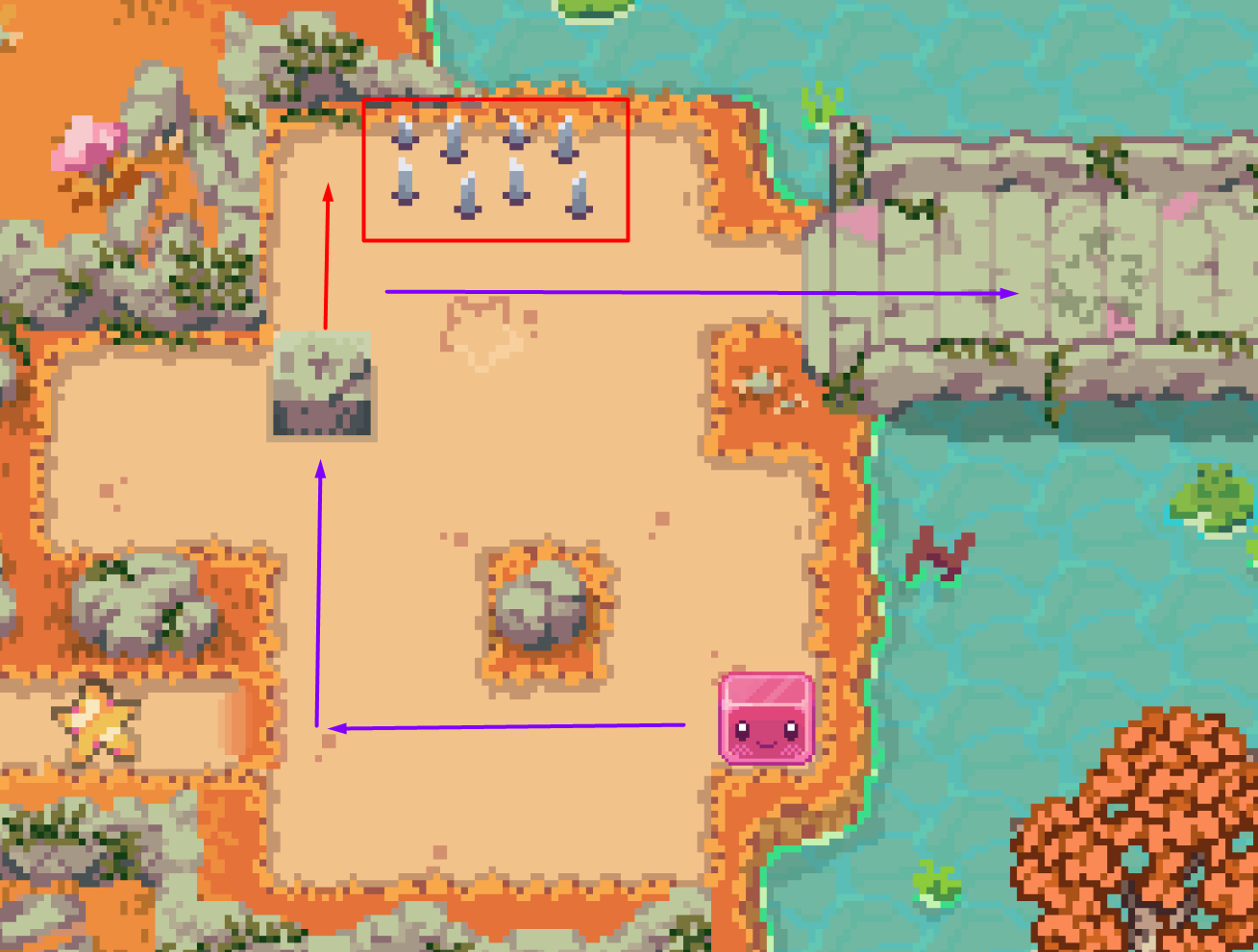
We always designed levels to subtly nudge the player closer to where they are supposed to be by mechanics or leaving clues to make them feel clever. Our design is ALWAYS centered around making the player feel clever. The screenshot above is a part of the box tutorial, the spike threat at the top immediately attracts the players attention to itself which is the place the box needs to be pushed to beat the room.

Points of Interest

(This is a particularly difficult room that has the solution highlighted subtly with this patch column and trail of gems.)

Slip N’ Slime has a very colorful array of art assets we’ve used throughout levels to give them personality and themes to keep the game fresh and pretty to look at with special points of interest around the levels, especially in areas we anticipate players getting stuck on. We also utilize points of interest to highlight gameplay elements, like I mentioned in the breadcrumb section, or to subtly give hints towards the solution in a hard puzzle.

Process Breakdown (World Map)

1: Research, Ideation, & Planning

Some of my first concepts and proposals for the difficulty curve, the tiny bubbles are feedback and conversations with the team
Planned curve with key levels we want to feature and use as milestones

Goal: How to create a difficulty curve to build our world map off of that is engaging and retains maximum player attention/energy?

Solution:

  • Researched various other games of the genre to understand what others have done.
  • Had team meetings and used Miro to record ideas and variations for different proposals.
  • Received back & forth feedback from lead that I used for iteration.
  • Categorized levels based on difficulty and made quick small demos to test feel.

Result: The concept solidified into a rule we are happy with for the time being, allowing us to further concept out the world map.

2: Fleshing Out & Making Proposals for World Map Orientation and Progression

Some of my ideation process along with feedback from team and new goals

Goal: How to structure world map pacing and progression that matches genre expectations while presenting the optimal way of retaining player attention and enjoyment.

Solution:

  • Built on the difficulty curve and ideas had during that creative process.
  • Researching and analyzing trends.
  • Created various iterations and proposals in Miro.
  • Worked closely with lead in receiving feedback, preferring proposals and rapidly making new iterations based on these communications.
  • Documenting goals and creating an identity of the world map to follow.

Result: After playtesting the prototypes, we finally settled on a final concept to iterate on and spend more time developing in detail.

3: The First Roughout

Miro level group layout and its in-engine implementation

Goal: Build the playable roughout of a level group (1/5th slice of the game) and test how it feels. Clarify our scope.

Solution:

  • Taking the final concept and building a detailed vertical slice of the game to implement in-engine and tweak. We were testing in smaller doses until now.
  • Iterated on multiple times after building all the levels and going through feedback on how individual sections felt.
  • Having a large scale slice of the game with our concept to play gave us a new perspective on game feel and cohesiveness informing how we will build level groups from now on.
  • After having detailed internal reviews, we collected some playtester feedback and combined all of it to make a list of priorities and goals we want to focus on when we work on the next version of a level group.

Result: We now have a solid foundation to build the rest of the game on, and I can expand on this concept’s details now that the team is happy with it

Highlights of the observations made by us and players along with proposed solutions

4: Iterating on the Roughout

Plans for each section and how we want to introduce mechanics
Snippet of our catalogue and my analaysis notes
Miro level group layout and its in-engine implementation

Goal: The iteration process was quite lengthy, and many variations were made whilst finding our footing, so we need a solid efficient pipeline for designing the rest of the level groups.

Solution:

  • I laid out the mechanics and focuses of each section of the game out, working with my other level designer Nick. We designed the exact experience and learning we want the player to have in the level group.
  • We had a large catalogue of levels both that we made during this process and from the past before I joined the team. I listed all the existing levels that have the corresponding mechanics for the level group and played through them taking notes about its content.
  • Using the notes mentioned in the previous section about what experience we want the player to have and the content of levels that already exist, I patched in levels that matched our goals, thus making the production time for this areas level shorter by recycling unused content.
  • Iterating on these levels introduced my idea of level sections (components of a level group) having their own unique themes that used mechanics and art assets to give a stronger identity to each section.

Result: This approach yielded a much quicker and stronger assembly of a level group that took less iteration cycles to be deemed complete as we had a much stronger foundation to build on.

5: Moving to the Blockout / Presentation

Ideations and concepts I made while preparing proposals
World map systems ideation's

Goal: We know how we want gameplay to feel, now how do we present it in-game?

Solution:

  • Research other games world maps and create as many valid proposals as I can.
  • Proposals are largely about the visual presentation but also about mechanical map interactions.
  • After the team came to a conclusion on what type of world map and progression mechanic felt the best for the project, I documented it and started preparing a ticket for our artists to begin creating the necessary assets.

Result: We had a finalized world map concept that felt the most appropriate to both our game’s feel and expectations of the genre. We can now begin to cement the elements of the game and start finalizing everything.

6: Finalizing the World Map & Beginning Art Work

Early concepts & sketches

Goal: The main focus of this iteration was to:

  • Finalize the player path and shape of the world map.
  • Find a presentation the team is happy with that also adheres to our set course so far.
  • Finalize the biomes of each section.

Solution:

  • Creating proposals and rapid iterations to receive feedback on until we found what felt the most correct.

Result: Finished the final composition for all the themes and biomes of the game. Finished the ticket and documentation for art and programming to begin working on necessary scripts and assets to have the world map shippable.

Our final concept and in the next part below, its evolution to shipped product.

7: Getting the World Map Over the Finish Line & Launch

Final shipped in-game screenshot of the world map

Goal: The main focus of this iteration was implementing art assets for all of the levels we’ve finished designing at this point as our artists finish the world map and its assets. Making any necessary tweaks to the map.
Solution:

  • Getting external feedback through playtesting to make sure we have all bases covered
  • Implementing small changes and QoL improvements to levels and the world map that we missed.
  • Adding juice!
  • Finishing level design and art. Now that we had locked in the biomes, we could add doing level art to our workflow instead of solely focusing on design.

Result: Finalized and shipped a detailed, comprehensive, and immersive world map that accomplished our project goals!

Level Design & Art Showcase/Timelapses

Levels that I designed and implemented art assets made by our team to make them ready to ship.